
Notices Without Delay: IRCC Moves Swiftly After Bill C-12 to Screen Out Late Refugee Claims

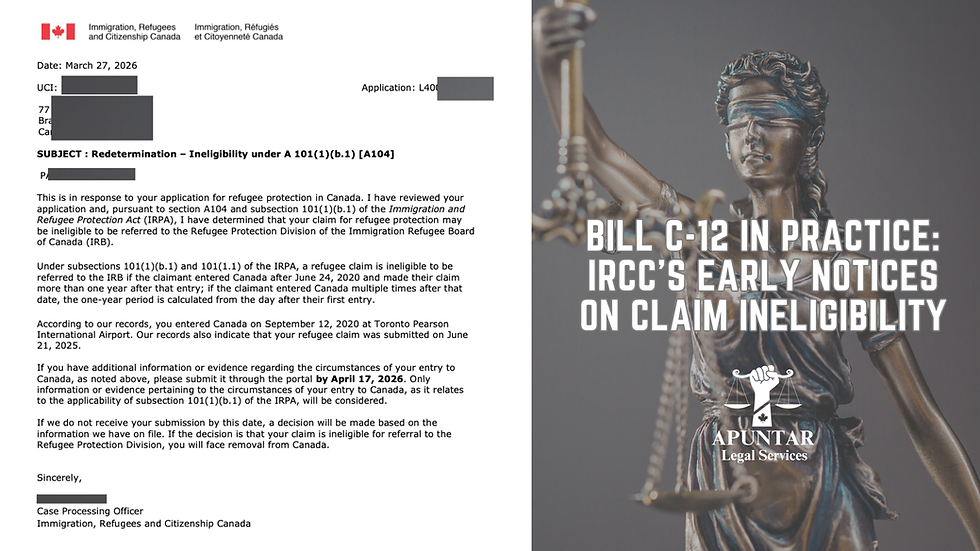
In the wake of Bill C-12 coming into force, many refugee claimants across Canada have been caught off guard—not just by the legal changes themselves, but by how quickly they are being enforced. Almost immediately after the law took effect, Immigration, Refugees and Citizenship Canada (IRCC) began issuing formal notices to individuals whose refugee claims were filed more than one year after their first entry into Canada.
These notices are not generic reminders. They are detailed, individualized letters that signal a potentially life-altering shift in how a claim will be processed.
What the Bill C-12 Notice Really Means
The language of the notice is technical, but its implications are profound. Relying on sections A104 and subsection 101(1)(b.1) of the Immigration and Refugee Protection Act (IRPA), IRCC is essentially saying this: if a person entered Canada after June 24, 2020 and waited more than one year to make a refugee claim, that claim may not even be heard by the Immigration and Refugee Board of Canada.
Instead of proceeding to a full hearing before the Refugee Protection Division—where testimony, credibility, and evidence are assessed in a robust, in-person setting—the claim may be declared ineligible altogether.
The notice also sets a strict and narrow deadline. In the example above, the claimant is given until April 17, 2026 to respond, and only on a very specific issue: the circumstances of their entry into Canada. This is not an opportunity to argue the merits of their refugee claim. It is a limited window to challenge the factual basis that IRCC is relying on—such as entry dates, multiple entries, or possible errors in records.
If no response is submitted, or if the response does not successfully address IRCC’s concerns, a decision will be made based on the existing file. And if the claim is found ineligible, the consequences are immediate and serious: the individual may face removal from Canada.
A Shift Away from Full Hearings
What makes this development particularly concerning is not just the outcome, but the process itself. Traditionally, refugee claimants have had access to an oral hearing before the IRB, a cornerstone of procedural fairness in Canada’s refugee system.
Bill C-12 changes that dynamic. By introducing a strict one-year filing limitation tied to entry dates, it effectively screens out certain claims before they ever reach a decision-maker at the IRB. For affected individuals, this means losing the opportunity to fully explain why they fear returning to their home country in a live hearing setting.
What Can Be Done
Despite the seriousness of the notice, it is not the end of the road. The response period—however narrow—is critical. This is where accuracy matters. If there are discrepancies in travel history, misunderstandings about entry dates, or unique circumstances surrounding how and when the individual entered Canada, these must be clearly documented and supported with evidence.
Beyond that, even if a claim is ultimately found ineligible, other legal avenues may still be available. Processes such as a Pre-Removal Risk Assessment (PRRA) or an application on humanitarian and compassionate grounds may offer alternative pathways, depending on the individual’s circumstances.
The key is acting quickly, strategically, and with a clear understanding of what IRCC is actually assessing at this stage.
How Apuntar Legal Services Can Help
At Apuntar Legal Services, we recognize that these notices are more than just legal documents—they are moments of uncertainty that require immediate and informed action.
We assist clients by carefully reviewing the notice, verifying the accuracy of IRCC’s records, and preparing focused, persuasive submissions within the tight deadlines imposed. Because the issue at this stage is highly specific, our approach is precise: we address exactly what IRCC is questioning, while positioning the case for the strongest possible outcome moving forward.
If the claim is found ineligible, we do not stop there. We guide clients through the next steps, whether that involves preparing a PRRA application, assessing humanitarian options, or identifying any legal errors that may warrant further challenge.
Responding with Urgency and Clarity
What Bill C-12 has made clear is that timing now plays a decisive role in refugee protection claims. And as these notices show, IRCC is not waiting to enforce the new rules.
If you have received a similar letter, it is important to understand that the deadline is real, the scope of response is limited, and the consequences of inaction are significant. But with the right guidance, there is still an opportunity to respond effectively and protect your future in Canada.
Apuntar Legal Services is here to help you navigate this critical moment—clearly, strategically, and without delay.


Comments