
Bill C-12 Explained: Key Changes, Legal Implications, and What You Should Do Now


What is Bill C-12?
Bill C-12, now law, introduces major amendments to the Immigration and Refugee Protection Act (IRPA). It changes how refugee claims are assessed, expands government powers over immigration applications and permits, and increases information-sharing between government bodies.
At its core, the law shifts Canada’s immigration system toward greater control, faster processing, and increased enforcement, with significant consequences for access to protection.
Refugee Claims
What are the biggest changes to refugee claims under Bill C-12?
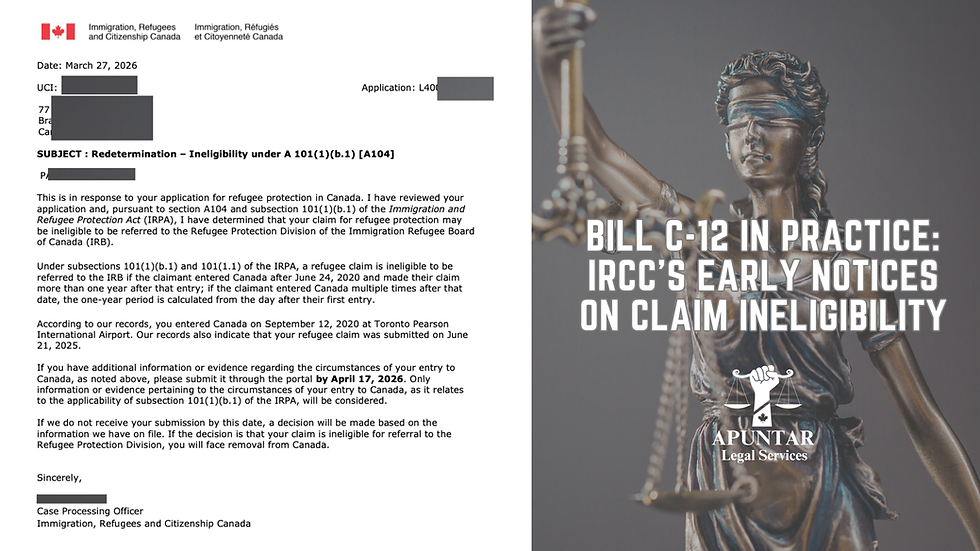
Bill C-12 introduces two major restrictions that affect whether a person can even access the refugee determination system under IRPA s. 100 (referral of claims to the Immigration and Refugee Board).
Instead of focusing only on the merits of a claim, the law now introduces strict eligibility rules, meaning some claims will never be referred to the Immigration and Refugee Board (IRB).
What is the new one-year limitation rule?
Under the amended eligibility framework in IRPA s. 101 (ineligibility of claims), a refugee claim will not be referred to the IRB if all of the following apply:
The claim was made on or after June 3, 2025;
The person first entered Canada after June 24, 2020; and
The claim was made more than one year after that first entry.
If these conditions are met, the claim is deemed ineligible, and the individual will not receive a full refugee hearing.
What happens if a claim is found ineligible?
If a claim is not referred under IRPA s. 100, the individual is redirected to a Pre-Removal Risk Assessment (PRRA) under IRPA ss. 112–113.
This is a major shift. It means that even individuals who may face serious risks in their home country could be denied access to the full refugee determination system.
What changed for people entering from the United States?
Bill C-12 also modifies the Safe Third Country Agreement framework under IRPA s. 101(1)(e).
Previously, individuals who entered Canada from the United States between official land ports of entry could, in some cases, become eligible to make a refugee claim after waiting 14 days.
That exception has now been eliminated.
As a result, individuals entering from the U.S. outside official ports of entry will generally:
Be found ineligible to make a refugee claim, and
Be directed to the PRRA process instead.
What is PRRA, and how is it different from a refugee claim?
A Pre-Removal Risk Assessment (PRRA) is governed by IRPA ss. 112–113 and is fundamentally different from a refugee hearing.
A refugee claim:
Is decided by the Immigration and Refugee Board (independent tribunal)
Typically includes an oral hearing
Provides broader procedural protections and appeal rights
A PRRA:
Is decided by an immigration officer (IRCC)
Usually does not include a hearing
Has limited procedural protections
Does not provide the same appeal rights
Does not automatically stop removal if refused and challenged in Federal Court
In short, PRRA is a more limited and less protective process.
Do PRRA applicants still have any rights?
Yes. Despite its limitations, PRRA applicants may still:
Apply for or maintain a work permit (subject to fees)
Access health coverage under the Interim Federal Health Program
However, timelines are strict and the process is more constrained than a refugee claim.
Who is not directly affected by these refugee changes?
At this time, the changes do not apply to:
Individuals who made refugee claims before June 3, 2025
Individuals already recognized as protected persons
Government-assisted refugees who already have permanent residence
Most applicants with ongoing spousal, H&C, or permanent residence applications
However, these individuals should still monitor developments, as other parts of the law may affect them.
What should you do if you may be affected?
Preparation is critical.
PRRA is invitation-based under IRPA s. 112, meaning you cannot apply unless invited by IRCC or CBSA. It is essential to ensure your contact information is up to date.
Once invited:
You typically have 15 days to submit the PRRA form, and
Another 15 days to submit evidence and written submissions
Given these short timelines, you should begin gathering supporting documents immediately, especially evidence of risk in your home country.
Seeking legal advice early is strongly recommended.
Government Powers Over Permits and Applications
What new powers does the government have under Bill C-12?
Bill C-12 introduces significant new discretionary powers under amendments to IRPA s. 87.3 and related provisions.
If the Minister determines it is in the “public interest,” the government may:
Refuse to accept new applications
Suspend or terminate processing of applications already in progress
Cancel, vary, or suspend existing immigration documents
These powers can apply broadly to categories of applicants, not just individuals.
What does “public interest” mean?
The legislation does not clearly define “public interest,” giving the government broad discretion with limited oversight.
This raises concerns because decisions could potentially be based on:
Nationality
Immigration category
Time of entry
Other group characteristics
Will permits be cancelled automatically?
No. The law does not automatically cancel permits.
Any action requires a formal government decision, typically through an Order in Council, which must:
Be issued by the federal government
Be tabled in Parliament within 15 days
Be published in the Canada Gazette
Until such action is taken, existing permits and applications remain valid.
What should you do if your permit or application is affected?
If the government exercises these powers:
You will likely receive formal notification
Immediate legal advice will be critical
There may be limited time to respond or challenge the decision
At this stage, the most important step is to stay informed and maintain valid documentation.
Information-Sharing Powers
What changes were made to information-sharing?
Bill C-12 expands information-sharing authority under amendments to IRPA provisions relating to disclosure and cooperation between government bodies.
Immigration-related personal information may now be shared:
Within IRCC
With federal departments and agencies
With provincial governments
With Crown corporations
This can include:
Identity information
Immigration status
Document history
Will this happen immediately?
No. Information-sharing requires formal agreements between government entities before it is implemented.
However, once in place, it may lead to increased monitoring and coordination across systems.
What does this mean for migrants?
For migrants, this means greater scrutiny—but also an important reminder:
You still have rights, including:
Workplace protections
Access to entitled services
Final Thoughts
Bill C-12 represents a fundamental shift in Canada’s immigration system. It changes not only how decisions are made, but whether individuals can access the system at all.
The introduction of strict eligibility rules, expanded government powers, and increased information-sharing signals a move toward a more controlled and enforcement-driven framework.
For those affected, the key takeaway is clear: timing, preparation, and legal awareness are now more important than ever.


Comments